About Me
I'm an engineer by training, a teacher by instinct, and a tinkerer by temperament.
I've spent most of my career helping people get from where they are to where they want to be with less friction.
Sometimes that means building a platform, automating away work nobody should have to keep doing, or changing a process. Sometimes it means sitting beside someone and figuring out why the thing that was supposed to make their job easier has somehow made it harder.
I've been writing software and building systems long enough to watch technologies arrive, become indispensable, fall out of fashion, and occasionally become fashionable again under a different name.
Years ago, a friend gave me a copy of one of Richard Feynman's books. One idea never left me: if you can't explain something simply, you probably don't understand it as well as you think you do.
That became something of a habit.
Learn something.
Do it.
Teach it to someone else. Bring them along for the ride.
Then discover what you didn't understand quite as well as you thought you did.
I didn't set out to make that a career philosophy. I just kept doing it.
More than once, I got involved with a technology early. I learned it, used it, contributed to it, wrote about it, taught it, and became part of the community around it. Along the way, I helped others learn enough to build something of their own.
As the world famous shampoo directions say: Lather, rinse, repeat.
Different technologies. Same rabbit holes.
From containerization and cloud platforms to DevOps, infrastructure as code, and now AI, I'm still chasing the rabbits.
Work is only part of it.
At the heart of my life is my family.
I'm a husband, a dad, and Pop-Pop. Those roles matter more to me than anything on my résumé, and they have a way of finding their way into the things I make.
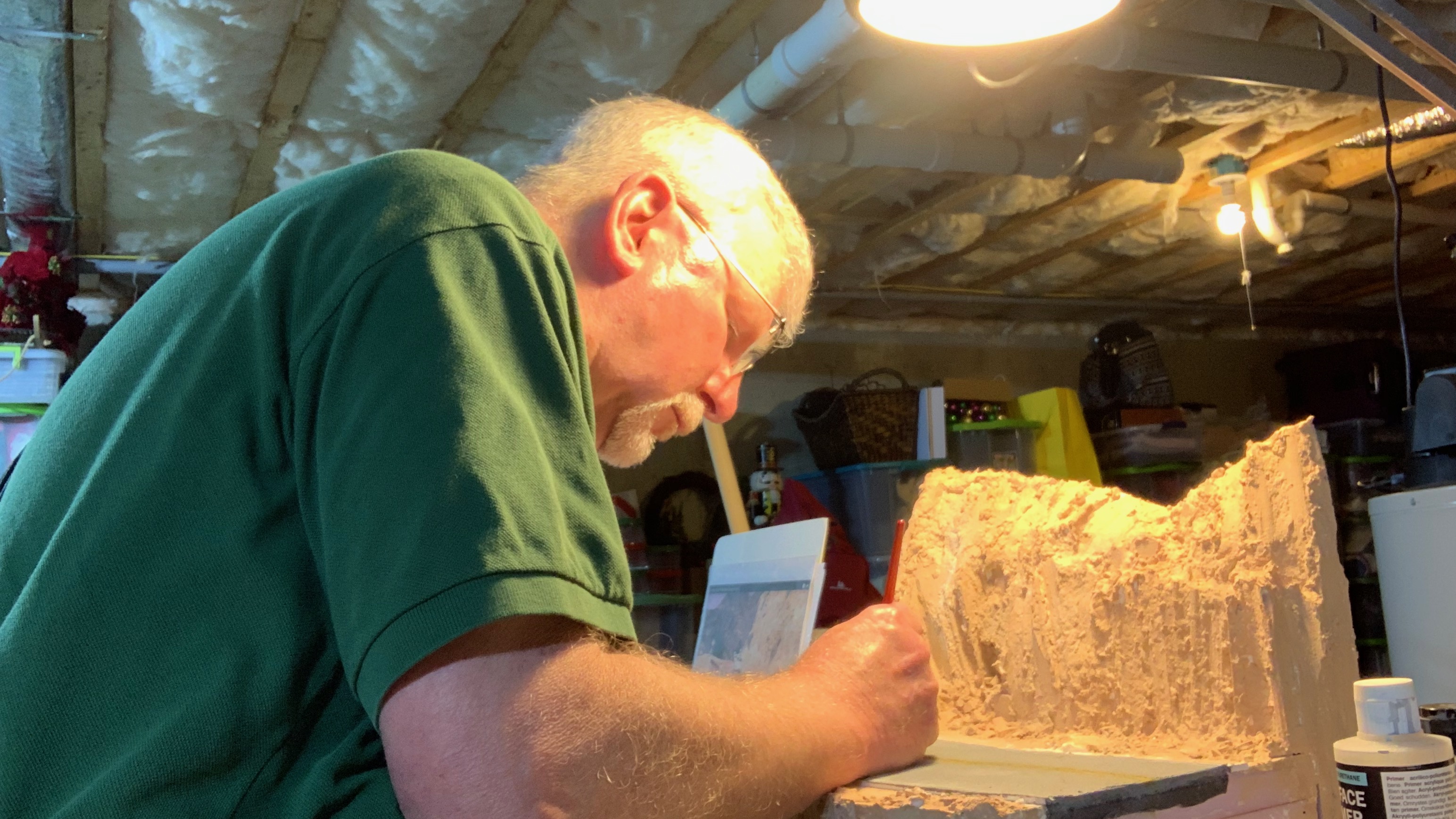
Most of my curiosity eventually winds up in either a text editor or on my workbench.
I build scale models and dioramas, which inevitably leads to microcontrollers, tiny LEDs, sound modules, resin casting, 3D printing, and occasionally wondering why I've spent an unreasonable amount of time engineering something almost nobody will ever notice.
Sometimes I'm building simply because I want to know whether I can.
Sometimes I'm building something for someone I love.
Both are pretty good reasons.
Of course, not everything I make needs a soldering iron or Sculpt-a-Mold.
I write. I play several musical instruments. I make soul-healing gumbo.
And I have been known to start researching one perfectly reasonable question and emerge several hours later knowing far more than anyone reasonably needs to know about an entirely different subject.
I don't expect that's going to change.
So, what am I doing here?
My Dad always told me, “You should try to learn something new every day.”
So, mostly, I'm still learning. And I'm insanely curious.
I'm interested in engineering, developer experience, AI, leadership, hiring, software delivery, and what happens when new technology collides with actual human beings.
I want to know why some tools make people better at what they do while others simply give them another tool to manage.
I want to know how complicated systems got complicated, and whether all that complexity needs to be there.
I want to know who we're actually solving the problem for, and whether anybody bothered to ask them what they needed.
After all these years, I'm convinced the most interesting question isn't what technology can do.
It's what people can do because of it.
Technology should help people become more capable, not more dependent.
That's what I'm exploring here.
Along with whatever happens to be on the workbench.