The Human Side of Technology
AI is Preventing Me From Getting a Job
I have submitted more than 140 carefully targeted applications during this job search.
Seventeen percent have resulted in any human follow-up at all.
So, naturally, I've spent a lot of time wondering what I'm doing wrong.
I'm beginning to think that's the wrong question.
When the Rational Adds Up to Irrational
Job candidates have spent years being told:
- Tailor every resume to the job description.
- Use the employer's terminology.
- Quantify accomplishments with value propositions.
- Lead with measurable impact.
- Optimize for ATS keyword matching.
- Keep summaries concise and targeted.
- Use action verbs.
- Don't just list responsibilities; show results.
And now: use AI to help you do all of this efficiently.
Then thousands of people do exactly that.
And the response from the other side is increasingly:
"These resumes all look alike. That's an AI marker."
Well...yeah.
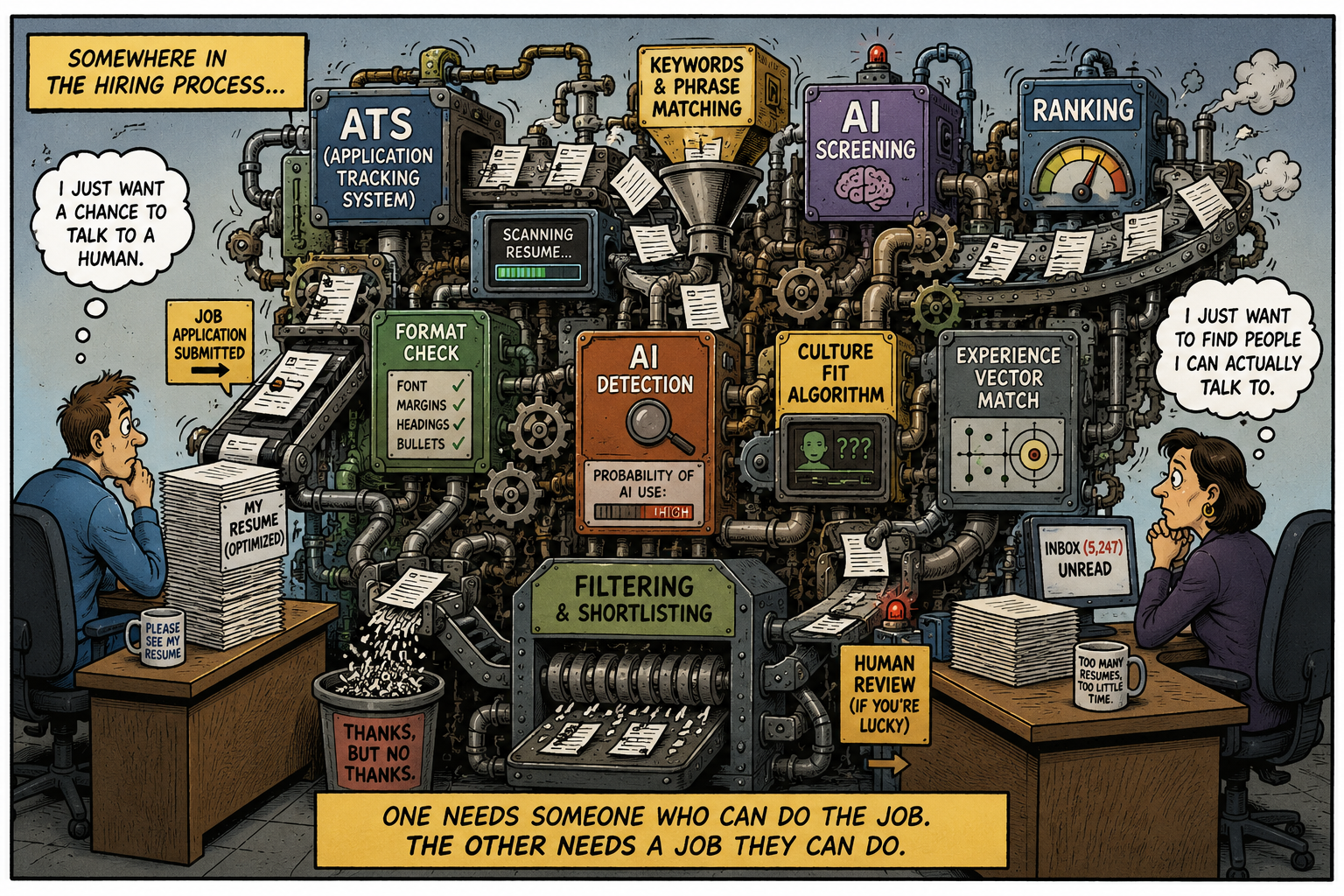
We've industrialized the process on both sides.
The hiring industry created a game in which applicants are encouraged to optimize their resumes against job descriptions because they know software and hurried humans will use those documents as filtering mechanisms.
AI simply made that optimization faster and available to everybody.
And now the optimization itself is being treated as evidence against the applicant.
The Rational
The hiring industry told me what to do.
Tailor the resume. Quantify the accomplishments. Mirror the language of the job description. Optimize for the ATS. Make every bullet demonstrate impact. Don't send the same generic resume everywhere.
So I did.
Eventually, I used AI to help me do it better — not to manufacture experience, but to take decades of actual experience and express the relevant pieces in the language of each particular opportunity.
Recruiters have a very real problem on the other side. In conversations I've had about the hiring process, I've heard numbers like 5,000 applicants and a month to fill the position.
I don't dispute that problem for a second.
I've also heard from plenty of other job seekers — dead cats were swung — and I can add my own experience of 140+ carefully targeted applications with only 17% receiving any human follow-up whatsoever.
Recruiters and candidates have different views of the same problem.
Candidates act rationally. They research ATS systems. They tailor. They quantify. They keyword-align. They hire resume writers. They use AI. They follow advice from recruiters and career coaches.
Recruiters act rationally. They need some way to turn hundreds or thousands of applications into a number of people they can actually talk to.
Companies act rationally. They deploy automation because humans cannot possibly process the volume manually.
Hiring managers act rationally. They become suspicious when application after application begins to sound the same.
Everyone is behaving rationally.
But, collectively, we've built something irrational.
The optimization creates more homogenization.
The homogenization creates distrust.
The distrust creates another filtering heuristic.
Candidates learn to optimize around the new heuristic.
And around we go.
They're Markers, All Right
AI markers aren't necessarily deception markers.
Even granting the premise — "Yep, you correctly identified that AI touched this resume" — what has actually been established?
Nothing about whether the experience described is true.
Nothing about whether the candidate can do the job.
Nothing about whether the accomplishment happened.
Nothing about whether the candidate understands the technology.
We've established that a tool was used to produce some prose.
I am not theorizing about what happens when someone uses AI to fabricate a career.
I've been using it to solve the precise problem candidates have been told to solve:
Describe your actual experience in language that better aligns with what this particular employer says it needs.
That's materially different from inventing experience.
And here's the part I cannot get past:
They're markers, all right. They're markers the hiring industry encouraged us to use.
The same industry that told candidates to use the employer's terminology.
The same industry that told us to quantify accomplishments.
The same industry that told us to optimize for keywords.
The same industry that told us to tailor every resume to every job.
And now similarity itself can become grounds for suspicion.
Then I Went Looking for Evidence
This started as a rant.
Then I made the mistake of doing research.
It got worse.
Indeed's current career guidance explicitly tells candidates to use ATS keywords to get their resumes noticed and explains that ATS systems can rank candidates based on employer-selected keywords. (Indeed)
In other words:
Use the employer's language so the machine recognizes you.
Gartner surveyed 3,290 candidates and found that 39% reported using AI during the application process. Only 26% trusted AI to evaluate them fairly, while 52% believed AI was screening their application information. (Gartner)
Think about that combination.
Candidates believe employers are using machines to evaluate them.
So candidates use machines to improve what they submit to those machines.
That's not irrational candidate behavior.
That's an incentive structure.
Meanwhile, application volume really has exploded.
LinkedIn has reported organizations seeing as much as a threefold increase in applicants, with automated mass-application tools contributing to the problem. Its earlier data showed applications for remote jobs soaring 146% while remote postings fell 46%. (LinkedIn) (LinkedIn)
Recruiters really are drowning.
But candidates are drowning, too.
And employers are responding with more AI.
LinkedIn reported in its 2025 Future of Recruiting research that 37% of recruiting professionals were already experimenting with or integrating generative AI into hiring. (LinkedIn)
So now we have:
Candidate AI → recruiting AI → more candidate optimization → more recruiting filtering.
We're staring the feedback loop squarely in the eyes.
"I Know It When I See It"
There's another problem.
Humans certainly recognize patterns they associate with AI.
That's different from demonstrating that humans can reliably determine authorship.
A 2025 study testing automated AI detectors and human raters found the human raters' overall accuracy at identifying different forms of AI-generated and human content was 19% — indistinguishable from chance in that experiment. (PubMed Central)
Software built specifically to detect AI has problems of its own.
A peer-reviewed evaluation found all tested AI-text detection tools below 80% accuracy, with both false positives and false negatives. (Springer)
A 2026 large-scale audit found considerable false positives in state-of-the-art detection systems. (AAAI)
NAACL research similarly found detector performance could deteriorate badly under real-world conditions. (ACL Anthology)
So the defensible conclusion isn't:
"Nobody can detect AI."
It's:
"Stylistic suspicion is not reliable evidence of provenance."
Just that sentence, with several three-syllable words, could get my statement flagged as generated by AI.
The statement is true regardless of who authored it.
And the recruiting industry itself recognizes the arms race. LinkedIn has predicted companies will increasingly introduce measures intended to catch AI use while simultaneously deploying more AI for top-of-funnel screening. (LinkedIn)
Read that combination again:
Candidates use AI.
Employers use AI to process candidates using AI.
Employers introduce mechanisms to catch candidates using AI.
Candidates adapt to those mechanisms.
Meanwhile, everyone says they want more authentic human interaction.
A Hollywood script couldn't design the absurdity much better.
And Then I Found Stanford
This is where things got really interesting.
In May 2026, Stanford University's Digital Economy Lab released "Algorithmic Monocultures in Hiring," by Rishi Bommasani, Sarah Bana, Kathleen Creel, Dan Jurafsky, and Percy Liang. (Stanford Digital Economy Lab)
The researchers analyzed roughly 3 million applicants making 4 million applications to nearly 2,000 positions, all screened using algorithms from the same hiring-assessment vendor.
They found something they call:
algorithmic monoculture.
When many employers rely on the same or similar algorithmic systems, those systems can repeatedly make similar judgments about the same people.
Four percent of applicants who applied to 10 positions were recommended for rejection from all 10 — a rate higher than expected by chance. (Stanford Digital Economy Lab)
Stanford describes the phenomenon as "systemic rejection." (Stanford News)
The researchers modeled what would happen if applicants applied more broadly and concluded that applicants would need to apply widely to increase the likelihood that their applications would eventually be considered by a human. (Stanford Digital Economy Lab)
Sound vaguely familiar?
A Correction Worth Making
I've seen claims floating around that the Stanford study proved ATS systems are sharing resume scores between employers, retaining those scores, and using them to reject applicants elsewhere.
That's not what this study establishes.
The viral interpretation appears to conflate ordinary ATS resume screening with the particular system Stanford studied.
The dataset involved Pymetrics game-based assessments, which measured characteristics such as focus, risk tolerance, and generosity and then algorithmically categorized candidates as recommended or not recommended. (Stanford News)
Stanford's concern is more subtle — and frankly more interesting:
If lots of employers use the same algorithmic vendor or similar algorithms, the same candidate can repeatedly encounter the same algorithmic judgment.
Nobody has to secretly pass your rejection score from Company A to Company B.
The shared methodology itself can create correlated outcomes.
That's what algorithmic monoculture means.
The study also identified significant racial disparities. Of applications from Asian applicants, 14.74% went to positions where the system adversely affected Asian applicants under U.S. employment-discrimination standards. For Black applicants, it was 25.87%. (Stanford Digital Economy Lab)
So this isn't simply:
"Some applicants don't know how to write resumes."
The filtering mechanism itself can produce systematic effects across employers.
And There's the Loop
Stanford's Digital Economy Lab has also looked more broadly at AI and labor markets.
Their researchers note that AI can lower the cost for employers to create postings and lower the cost for candidates to apply.
That could improve matching.
But it could also make matching worse by diluting labor-market signals.
And then Stanford gives me almost exactly my premise:
If all resumes start to look the same, it can become harder to form good matches. (Stanford Digital Economy Lab)
Uh...
- AI makes applications easier.
- Application volume increases.
- Candidates use AI to improve their presentation.
- Resumes become more homogeneous.
- Employers have more difficulty distinguishing candidates.
- Employers introduce more algorithmic filtering.
- Those filters can produce correlated judgments across employers.
- Candidates respond by applying more broadly.
- Which increases application volume.
There's our loop.
And here's the part that really gets me.
Back in 2018, Stanford professor Adina Sterling was already warning that automated hiring systems looking for specific criteria could screen out qualified applicants who lacked the "right buzzwords to get through the filters." (Stanford Engineering)
Think about the progression:
2018: Candidates may need the right buzzwords to get through automated filters.
2026: Recruiters complain that resumes contain the same words and structures and regard those similarities as AI markers.
The Bottom Line
This isn't:
AI is bad.
It isn't:
ATS is bad.
It isn't:
Recruiters are bad.
It isn't:
Candidates are bad.
And it isn't even:
Companies shouldn't try to detect fraudulent applications.
It's this:
We have created a hiring system in which everyone is responding rationally to everyone else's automation, and the collective result is increasingly irrational.
Employers automated because application volume became unmanageable.
Candidates optimized because automated screening made optimization necessary.
The industry taught candidates how to optimize.
AI made optimization dramatically easier.
That increased volume and homogenization.
Employers became suspicious of homogenized applications.
So employers introduced more automated screening and new authenticity heuristics.
Which gives candidates even greater incentive to optimize around those.
It's an arms race.
And somewhere underneath all those layers of optimization are two humans who actually need to accomplish something remarkably simple:
One needs someone who can do the job.
The other needs a job they can do.
References
- Get Your Resume Seen With ATS Keywords | Indeed.com
- Gartner Survey Shows Just 26% of Job Applicants Trust AI Will Fairly Evaluate Them
- 7 Ways HR Will Look Different in 2025
- LinkedIn Report: 6 Predictions for the Future of Recruiting
- LinkedIn Report: How AI Will Redefine Recruiting in 2025
- Ability of AI detection tools and humans to accurately identify different forms of AI-generated written content - PMC
- Testing of detection tools for AI-generated text | International Journal for Educational Integrity
- A Large Scale Social Web Audit of AI Generated Text Detection Systems
- A Practical Examination of AI-Generated Text Detectors for Large Language Models
- How AI Will Change Recruiting in the Next 6 Months
- Algorithmic Monocultures in Hiring - Stanford Digital Economy Lab
- AI hiring tools show racial bias | Stanford Report
- AI and Labor Markets: What We Know and Don't Know - Stanford Digital Economy Lab
- Adina Sterling: How will artificial intelligence change hiring? | Stanford University School of Engineering