The Human Side of Technology
AI is Preventing Me From Getting a Job: Here We Go Loop-d-Loop
Narrative for humans. Structured chronology for machines. Truth underneath both.
One Christmas morning, when I was a preteen, I awoke to find a small, red, white, and blue airplane under the tree. Santa, being the ever-present hobby guide, had left it for me and made my Dad grin like the Cheshire cat!
I had grown up wanting to be an astronaut and wanting to learn how to fly, and now, here in my hands, was not just any other model airplane kit, but one that would actually fly. The Cox Pitts Special decorated in Art Scholl colors, complete with a gas engine and all of the things needed to get this stunt monster off the ground.

Turns out, it isn't as easy as it looks (to tell it here would be to digress way too much), but it opened the gates.
Once I had achieved the goal of keeping model airplanes in the air, the next logical maneuver was the loop. On a control-line plane the concept is pretty simple: you just pull back on the lines and draw a circle with your hand at the end of your arm and your plane will describe a perfectly good loop at the end of the lines.
Yeah. Right.
But after a while, things start to click and you want to do more complex things with the plane, like square loops, triangular loops, and so much more.
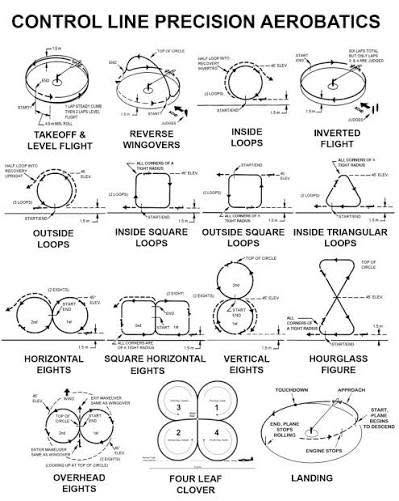
Good memories and friends were made around this whole process and I'm returning to the circle soon, but this isn't about flying model airplanes, it's about loops.
The Sharp Turn at the End of the Line
I'll call this the Bugs Bunny Navigation Problem.
Our careers are not neat little straight lines like we all imagine when we enter the working world. Sure, we may work for many different companies along our timeline, but the actual career makes a left turn at Albuquerque (or Schenectady) several times.
Then, we may find ourselves back in the job market and what we've been asked to do is an endless set of loops:
**Analyze Job Description -> Modify Resume to Fit -> Create Compelling Cover Letter -> Submit the Application -> Wait**
We're pretty much modifying bullet points about chronological adventures when that really doesn't fit. I wasn't thinking about résumés when this occurred to me.
I was writing.
In this particular case, I was writing something that required a lot of evidence to support my theme. The pattern is really basic:
Write Cite
The spark for this kind of writing starts when I run across something that makes me stop and think or ask questions. I go looking for answers and, if I find something interesting or even contrary, down the rabbit hole I go. At some point, I pull all of this back together in a way that makes sense to me and write about my findings. More so, when trying to make project documentation clean and easy to read.
Now, I had a new question: what if our career presentation were more like a research paper, and less like some chronological collection of bullet points? What if we did the same kinds of things across companies as our career progressed?
What if the companies were the citation, rather than the story?
Careers aren't neat chronological sequences. They're networks of experiences whose connections often aren't obvious until somebody starts pulling on the lines. That's where Career Archaeology enters.
In Part 1 of this series, I described the loop we're flying in the job market. In Part 2, I tried breaking it: excavate the career first, then build the résumé from what we find. In Part 3, I shipped the result.
And it broke.
Workday, in this case, needed something the narrative résumé wasn't giving it: structured chronology. So I added an interface for the machine without sacrificing the story for the human.
Then something else happened.
That application produced an interview within a very short time.
One application. One result. That's not evidence of much of anything.
Yet.
That's why I am asking for your help.
Okay. Your Turn.
Enough about my résumé.
Let's dig up yours.
I'm making the Career Archaeology artifact available for you to download at the end of this post. It's the same basic process we used to excavate my career before we tried to write a narrative résumé.
You'll need two things:
- The Career Archaeology Markdown file.
- The broadest, most complete résumé you have. Don't worry about whether it's pretty. We're looking for evidence, not typography.
Upload both to whatever AI collaborator you use.
Then tell it this:
Based on the résumé and Career Archaeology instructions I've provided, interview me to help us discover the problems I've solved, decisions I've made, failures I've learned from, outcomes I've produced, and patterns that recur across my career.

Do not begin writing or rewriting my résumé yet.

Ask follow-up questions when an answer deserves deeper excavation. Our eventual goal is to create v0.1 of a narrative résumé organized around the problems I solve rather than simply my employment chronology.
And then talk to it.
This is the part I don't want you to automate.
Correct it when it's wrong. Challenge an interpretation that doesn't feel right. If a question reminds you of something that happened fifteen years ago, follow it. Tell the story. Give it counterexamples. Say "no, that's not really what happened."
Your AI collaborator wasn't there.
You were.
Make the ridiculous résumé
Eventually, once you're satisfied that you have provided enough information in the interview, ask your AI collaborator to create Narrative Résumé v0.1.
And give yourself permission for v0.1 to be ridiculous.
Ten pages? Fine.
Repetitive? OK.
Too many stories? Yep.
Things you're not sure belong? Don't worry about it.
We're excavating. We haven't started packing for the trip yet.
Now interrogate what you've found.
What problems keep recurring?
Where does your judgment show up?
Which stories have evidence behind them?
Which claims sound impressive but don't actually have receipts?
Where did you fail?
What did you learn?
Are there counterexamples that change the story?
What do you know now that you couldn't have known when you wrote the résumé you started with?
That's the material. That is your baseline.
Using everything we've uncovered, help me create a persistent baseline narrative résumé.

Organize it around the recurring problems I solve, the judgment and principles I bring to those problems, and specific evidence from my career that supports each narrative.

Do not optimize this résumé for a particular job description.

Preserve my actual employers, titles, dates, technologies, responsibilities, and outcomes. Do not invent or strengthen claims beyond the evidence we've uncovered.

Where the evidence is weak, contradictory, or incomplete, tell me rather than filling the gap.
From there, build the persistent version of your narrative résumé, the one that describes the problems you solve and the evidence that you can solve them.
And don't throw away the boring stuff.
Keep your real employers. Your real titles. Your real dates. But put the narrative first.
Part 3 of the series taught us why.
Narrative for humans.
Structured chronology for machines.
Truth underneath both.
Save your v0.1 narrative resume. You'll use it for the next step.
Now, show it a job description
Notice how late the job description enters this process.
That's intentional.
Only after you've excavated the career and built the baseline should you introduce the job you're considering.
Then ask:
Here is a job description I'm considering. Compare it against my baseline narrative résumé and career evidence.

Identify the problems and experiences most relevant to this role. Recommend what to emphasize, compress, reorder or remove.

Do not add technologies, responsibilities, accomplishments or experience that aren't supported by my career evidence. Preserve my actual titles and chronology.
That's a very different instruction from:
Tailor my résumé to this job.
We're not asking AI to make your career look more like the job description.
We're asking it to select the most relevant evidence from the career you've already excavated.
Read the result. Don't gloss over anything.
Check the chronology. Check the skills. Check every claim. Make sure the machines have the structure they need.
And ask yourself one last question:
If somebody points at any sentence on this résumé during an interview, can I comfortably tell the story behind it?
If not, fix it.
Then ship it.
And please tell me what happened.
This is where my experiment becomes our experiment.
I've been Candidate Zero.
A couple of people have already begun running the experiment independently.
Now I'd like more data, if you're willing to help.
You don't have to apply for a job to participate. Run Career Archaeology. Build the narrative résumé. Tell me what happened.
If you are job hunting and decide you're comfortable using it in a real application, I'd especially like to know what happens next. Spare no details, even the gory ones.
I'm including a short Career Archaeology Field Report. Six questions. It should take about fifteen minutes.
I don't want your résumé. Please don't send me confidential company information, proprietary material, or anything else you don't want me to see.
I want to know what happened when you tried the process.
What did it uncover?
What was useful?
What was confusing?
What didn't work?
Did it change how you think about your career?
And, if you eventually used the résumé for a real application, what happened?
Good results, bad results, weird results—I want all three.
These aren't testimonials.
They're field reports.
And I'm not going to rewrite the process because Candidate Three doesn't like Question Seven. 😂
Let's get some observations first. Find the patterns. See where the process breaks. See whether the results are repeatable.
Then we change it.
Build → Ship → Observe → Learn → Revise.
And around we go.
Funny.
That sounds suspiciously like engineering.