The Human Side of Technology
Several Recruiters Later...
Are you familiar with Spike Jones, the brilliant musical parodist?
He and his "orchestra," the City Slickers, delivered pointed, side-splitting musical spoofs to audiences far and wide. Certainly, you'll remember All I Want for Christmas Is My Two Front Teeth, even if you never knew who was behind it.
Absurdity at its finest.
I love it.
I am reminded of Spike every time I use the #OpenToWork hashtag on LinkedIn. I can practically hear the recruiters coming out of the veritable woodwork to the tune of his ridiculously frantic rendition of Tiger Rag.
And I'm reminded of the absolute absurdity of having to vet the people who contact me.
Every. Single. Time.
It's become quite the chore, you know?
The Recruiting Parade
One recent Monday morning, I received five unsolicited recruiting approaches in considerably less than an hour.
Five.
Another six in the hours following that.
Some of the messages were extraordinarily complimentary. Apparently, my background was impressive, my experience exceptional, and my leadership precisely what someone, somewhere, desperately needed.
Well, that's nice.
Naturally, I wanted to know what the jobs were.
That's where the music started.
One recruiter was eager to introduce me to a hiring manager but couldn't tell me much about the position.
Another knew an astonishing amount about my career and described a potentially attractive opportunity with a recognizable company. Unfortunately, I couldn't establish whether the sender was actually the person whose name appeared on the message.
Another offered career advice based on a job I no longer held.
One eventually provided two detailed descriptions of positions that genuinely interested me. That was encouraging, although I still had questions about the sender's identity and relationship with the employers.
And another wanted to discuss an exciting leadership opportunity without identifying the actual opportunity.
I could almost hear Spike Jones blowing a whistle.
Now, I can't establish that my LinkedIn activity caused this sudden burst of attention. The timing was remarkable, but timing isn't proof of causation.
Still, the experience was something to behold.
And it wasn't entirely new. I'm beginning to recognize a pattern, because I've seen it several times before. (Human pattern recognition...who'd a thunk?)
Over the past several months, I've received numerous messages from people claiming to represent major corporations, confidential executive searches, retained recruiting engagements, and promising AI startups.
Some have been perfectly legitimate.
Others have left me scratching my head.
Consider this fictional composite, assembled from patterns I've encountered (and, you've been looking for work, you may find this familiar):
Hello,
I was extremely impressed by your extensive experience and exceptional leadership background.
We are conducting a confidential search for a highly respected global organization seeking a senior engineering leader.
The opportunity offers excellent compensation, flexible working arrangements, and significant career growth.
Due to the confidential nature of the engagement, we cannot disclose the client or official job requisition until the next stage.
Please forward your updated résumé so we can proceed.
My response is usually some variation of:
"Thank you. What's the job?"
The answer is confidential.
"Who's the employer?"
Also confidential.
"Can you tell me how you're connected to the employer?"
Well, that's complicated. I've had less complicated relationships.
"But you'd like my résumé?"
Yes, please. At your earliest convenience.
"And you'd like me to join a Teams meeting where a hiring manager is just standing by?"
I’ve already informed him that you’ll be reaching out. Once you connect, simply mention that you were referred by me, and they should be able to assist you promptly.
Cue the slide whistle.
But There's Something Behind the Absurdity of it All
It's easy to laugh at these exchanges. I certainly do. Of course, I'm the guy who will keep a telemmarketer or computer repair team on the phone for a long time. I may be slightly twisted.
Sometimes the whole experience feels like an elaborate comedy routine in which everyone has memorized their lines except the person looking for work.
But there are real people behind those green #OpenToWork banners.
People with families, mortgages, responsibilities, and years of experience. People who want to contribute, who want to have a purpose, who may be worried about their futures, and who deserve to be treated with dignity.
And there are legitimate recruiters trying to do their jobs.
I've worked with some good ones. Thoughtful professionals who understand the roles they're filling, communicate clearly, and recognize that the person on the other end of the conversation is more than a résumé.
They deserve to be treated with dignity, too.
In fact, I suspect they're among the people most frustrated by questionable recruiting approaches.
Because every interaction that leaves a candidate wondering whether someone is genuine makes the next legitimate recruiter have to work a little harder.
Trust becomes something that has to be established before the conversation can even begin.
And, as Jim Lovell almost said, we have a problem*.
A Little Knowledge Is a Dangerous Thing
I was humming A Little Knowledge Is a Dangerous Thing by my favorite band, Tower of Power as I typed that heading.
But I digress.
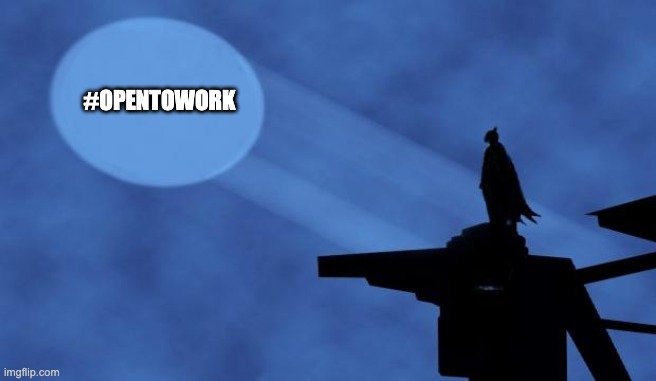
You've just announced that you're looking for work. And the whole planet saw it. Or at least some of it.
Geez, I hope that someone who can help, saw it.
That hashtag can be useful. It's why the feature exists.
But it can also attract people whose intentions, credentials, or actual recruiting relationships aren't immediately clear.
Over time, I've noticed a few recurring patterns.
- A recruiter claims to represent a major corporation but contacts me from a generic email address.
- Someone describes an extraordinary opportunity but can't establish a relationship with the hiring organization.
- A confidential search becomes so confidential that even the most basic questions seem impossible to answer.
- Someone wants to move the conversation to Signal or WhatsApp before we've established who we're talking to.
And sometimes a wonderfully enthusiastic exchange ends abruptly when I ask for something I can independently verify.
Poof.
Another instrument of dubious nature becomes part of the crazy tunes orchestra.
None of these behaviors, individually, proves dishonesty.
Legitimate independent recruiters sometimes use Gmail. Confidential executive searches are real. People get busy, change priorities, and occasionally forget to respond.
And some people simply aren't particularly good at communicating.
I've had days like that myself.
My concern arises when several of these behaviors appear together, particularly when reasonable questions consistently go unanswered.
Asking for verification isn't an accusation.
It's a reasonable part of establishing a professional relationship.
Authentication Is Not Authorization
Now we're going to get a little technical.
I'll try not to ruin the music.
LinkedIn offers several forms of verification, including identity verification, workplace verification, and a Verified Recruiter label.
According to LinkedIn's documentation on workplace verification through a Recruiter license, qualifying recruiters can display a label associated with their verified company affiliation.
That's useful.
But suppose a recruiter works for an independent agency.
Verifying that the recruiter works for that agency doesn't necessarily establish that the agency is authorized to recruit for the company named in a message.
And it doesn't establish that a particular job exists.
These are different things.
Authentication is not authorization.
Verifying someone's identity is not the same as verifying where they work.
And verifying where they work isn't necessarily the same as verifying their authority to represent another organization.
It's a distinction that engineers and security professionals encounter regularly, but its importance extends well beyond technology.
When someone approaches a job seeker claiming to represent an employer, what has actually been verified?
That's a question worth answering.
To be fair, the absence of a LinkedIn verification label doesn't mean someone is illegitimate. The available mechanisms don't cover every recruiting arrangement, and plenty of legitimate professionals operate without those labels.
But that makes clarity about what verification does and doesn't mean even more important.
A badge can help establish trust.
It shouldn't require us to guess what the badge establishes.
When the Candidate Becomes the Investigator
I've developed a routine.
When an unfamiliar recruiter contacts me, I may examine their LinkedIn profile, employment history, company website, email domain, corporate relationships, and any publicly available job postings.
Sometimes I find enough information to feel comfortable continuing.
Sometimes I don't.
I have the experience, curiosity, and technical skills to do that research.
But should I have to?
And what about candidates who don't have the time, resources, or inclination to conduct that investigation?
Looking for work is already work.
There's the searching, the applications, the resume tailoring, the interviews, the waiting, and the occasional rejection that arrives so long after an application (I had one that went over 90 days) that you have to remind yourself which job it was. It's a good thing I am keeping track with a much too detailed spreadsheet that prevented me from creating a MySQL database.
Then there are the opportunities that simply disappear into the ether.
Poof
Add investigating recruiting claims to the process, and it's no wonder people become exhausted.
There's also the occasional suggestion that a candidate must first purchase résumé assistance or some other service before being considered.
That's a different kind of concern, and one I've written about before.
But the common thread is that someone looking for work is being asked to invest trust, time, and sometimes money before the opportunity itself has been established.
I don't think that should be the normal starting point for a professional relationship.
What If the Recruiter Needs Protection, Too?
One encounter has stayed with me.
A young developer approached me about a senior engineering leadership opportunity.
His LinkedIn profile contained technical writing, software projects, and an ambitious AI-powered recruiting application.
He appeared to be someone interested in building things and developing his career.
But the opportunity he described raised questions.
The relationships between the companies were unclear. I couldn't independently verify the position. And he wanted to move the conversation to Signal, so I could speak with the hiring manager.
Eventually, I asked whether he had independently verified the people who had engaged him to recruit.
Because something occurred to me.
What if he wasn't trying to mislead me?
What if someone had misled him?
I don't know the answer. He hasn't responded. It's been days.
And I don't want to suggest wrongdoing without evidence.
But the possibility matters.
People who are early in their careers, eager to establish themselves, or excited about a new business opportunity can be vulnerable, too.
Not every questionable recruiting interaction necessarily begins with a dishonest recruiter.
Sometimes the person delivering the message may not fully understand what they've become involved in.
That's another reason I think this deserves a conversation grounded in empathy rather than accusations.
The people on both sides of the exchange may need protection.
LinkedIn, Can We Make This Better?
I've spent a career building and improving systems.
One thing I've learned is that identifying a problem is usually easier than designing a solution that works for everyone affected.
And this problem is not simple.
Recruiting relationships can involve independent agencies, subcontractors, confidential engagements, temporary authorizations, and business arrangements that change over time.
I wouldn't expect LinkedIn to certify every job or guarantee that every message is legitimate.
But I do think there's room to make professional relationships easier to verify.
I'd start with three ideas.
First, help employers verify recruiting relationships.
Where practical, give employers a way to confirm which external recruiting organizations or individuals are authorized to represent them.
That wouldn't solve every problem. Confidential engagements would require special consideration, and relationships would need to be maintained as they changed.
But even partial progress could help legitimate recruiters establish credibility more easily.
Second, make the meaning of verification unmistakable.
Verified identity, verified employment, and verified authority to recruit for another organization are not interchangeable.
Tell us what's been verified.
And just as importantly, don't imply that someone is untrustworthy simply because a particular verification isn't available.
Third, make reporting more useful.
LinkedIn already has reporting mechanisms and policies prohibiting fraudulent or misleading conduct.
Those are important safeguards.
But when candidates report recurring patterns of questionable recruiting claims, I'd like to see those reports contribute to meaningful investigation and accountability. And perhaps, change.
If we, the citizens of LinkedIn, are expected to serve as ersatz investigators (yay, I've always wanted to use that word), it would be nice to know our efforts were helping.
None of these suggestions is trivial.
And none would eliminate fraud, misleading representations, or plain old human misunderstanding.
But they could make legitimate recruiting easier to recognize and make the professional network a little more trustworthy for everyone.
Trust Is Something We Build Together
I went back and read LinkedIn's User Agreement.
Section 3.3 acknowledges that information provided by members may be misleading or harmful, disclaims responsibility for offers made by others, and explains that LinkedIn doesn't supervise individual members' recruiting offers.
I understand why those provisions exist.
A platform of LinkedIn's scale can't personally supervise every conversation, and no reasonable person should expect it to guarantee every opportunity.
LinkedIn also has Professional Community Policies prohibiting fraudulent and misleading behavior, along with reporting and enforcement mechanisms.
Those protections matter.
But policies and the everyday experience of trust aren't quite the same thing.
A policy can prohibit misrepresentation.
A well-designed system can also make misrepresentation more difficult.
And a community can reinforce both through its own behavior.
Candidates should represent their experience honestly and exercise reasonable judgment.
Recruiters should communicate clearly, respect candidates' time, and be prepared to establish their professional relationships when appropriate.
Employers should help candidates and recruiting partners understand who is legitimately representing them.
And LinkedIn has an opportunity to make all of that easier.
Not because LinkedIn is responsible for every dishonest person who uses its platform.
But because it has built something valuable around the idea that professional relationships matter.
The more important a platform becomes to professional life, the more important it becomes to protect the trust that makes those relationships possible.
And there's a practical benefit to everyone involved.
Candidates can spend more time exploring opportunities and less time investigating them.
Legitimate recruiters can spend more time connecting people with meaningful work and less time overcoming suspicion.
Employers can make their hiring relationships clearer.
And LinkedIn can strengthen the professional community that gives the platform its value.
I still have that Spike Jones performance playing in my head.
The whistles. The horns. The improbable tempo. The delightful sense that the whole thing might fly apart at any moment.
Some mornings, that's what being a job hunter feels like.
And I expect there will be more mornings like it.
I'll keep asking questions. I'll keep verifying what I can. I'll keep laughing when the situation deserves a laugh.
But I'll also try to remember that there's a person on the other side of every message.
Sometimes that person is trying to help.
Sometimes they're confused.
Sometimes they may need help themselves.
And sometimes I may never know which.
Professional trust isn't something we can create with a badge or protect with a policy alone.
It's something we build together, through honesty, accountability, transparency, and the willingness to treat one another with dignity.
LinkedIn has an extraordinary opportunity to help lead that effort.
I hope it will.
And to the next recruiter who contacts me with an exciting, confidential, once-in-a-lifetime opportunity:
I'm happy to talk.
Really.
But could you please tell me what the job is?
Cue the slide whistle.
* What Lovell actually said was, "Houston, we've had a problem.". It's all good Ron, we love good drama.